Category Archives: Signing with Young Children

Signs and Rhymes: An Interview with Dawn Babb Prochovnic

Today we have a special treat – an interview with Dawn Babb Prochovnic, the author of sixteen picture books in the Story Time With Signs & Rhymes series (Abdo Publishing Group) and the founder of SmallTalk Learning.  Each Story Time With Signs & Rhymes book focuses on a different topic, from animals to food to school signs, and introduces basic American Sign Language through a fun rhyming story and colorful illustrations.  Dawn blogs at http://www.dawnprochovnic.com/

MyPictureCatalogSummary


Without further ado, here’s the interview!

1) How did you first become interested in sign language (and in particular, signing with hearing children)?

I took an interest in sign language as a young child. I was raised on three episodes of Sesame Street a day and enjoyed watching Linda Bove use sign language to communicate. When I was in grade school I volunteered in what was then called the “special education classroom” and enjoyed using sign language in that environment.

When I started planning for my own family in the mid-1990’s, I learned about the idea of signing with hearing babies. I read books, watched videos, researched web sites and took signing classes in my local community to expand my signing vocabulary. When my first child was born in 1999, our family embraced signing as an important part of our early communication with our daughter. Signing made it possible for her to tell us what she was thinking and what she needed before she was able to clearly communicate verbally. Back then, signing was more of an alternative thing to do with your hearing baby—it was definitely not mainstream. Our positive experience garnered the attention of other families around us. Soon, friends began asking for informal workshops.

I have an MA in organizational communication, and much of my pre-kid professional life was in the field of corporate training and development, teaching grown-ups how to communicate with each other. In the year 2000, I left my corporate job and started SmallTalk Learning (www.smalltalklearning.com), a company that specializes in teaching sign language workshops to hearing families and educators. I love teaching, I love writing, and I deeply value family and communication. Teaching signing workshops and writing books for children enables me to blend all of these interests.

2) How did you come to write the “Story Time with Signs & Rhymes” series?

When I started teaching infant/toddler sign language workshops, I quickly discovered that the most effective way to help participants learn and remember particular signs was to teach them catchy songs they could sing and sign while they interacted with their babies and toddlers.  I wrote all kinds of ditties for this purpose, modeled after familiar children’s songs and rhymes like “Old MacDonald Has a Farm” and “Oh My Darlin’ Clementine.”

Over time, I became more interested in the early literacy benefits of signing in addition to the pre-verbal benefits, and I discovered that preschoolers and elementary school children were especially keen on sign language. I wanted to share the extraordinary experience of signing with more children than I could reach in my own classes. The “Story Time with Signs & Rhymes” series grew out of that vision.

In the summer of 2004, I attended my first of many writing conferences, and I formed a critique group so that I could refine my writing skills, transform my classroom songs into stories, and learn about the business of publishing. After many rounds of critique, countless revisions, and heaps of submissions and rejections, I signed my first publishing contract in March of 2008. I currently have 16 books that have been published in the series.

3) What made you decide to take a story-like approach to the series, when so many ASL books take a nonfiction approach?

I was trying to fill an unmet need. As baby signing shifted from alternative to mainstream, a variety of sign language resources became available: board books and picture dictionaries for babies, instructive books for middle graders, “How to Sign with Your Baby” guidebooks for parents, and many different videos and websites. At the time, there were a few fairy tales and nursery rhymes translated into Signed English, but there were no original, story-based picture books for preschool and elementary aged children that incorporated sign language. The Story Time series was designed to give children interested in ASL a logical next step after board books and picture dictionaries.

The playful, rhythmic, nature of the stories encourages parents and caregivers to read, sign and rhyme with their children, which helps build early literacy skills. My overall goal for the series was to create stories for children to interact with and get hooked on reading and signing.

 4) Tell us a bit about the process for each book.  How do you decide on the topics?  How much do you collaborate with the illustrator?

Most of the themes for the stories grew out of the songs I sing in my signing workshops to teach the signs for early childhood concepts such as animals, colors, and things-that-go. Each book tells an original story that is fun to read/chant/sing with children while they sign along with key words in the text. Think: “The Wheels on the Bus,” or “The Itsy Bitsy Spider,” but instead of incorporating random hand gestures for “round and round,” and “up the water spout,” children can sign along with key words like “red,” “blue,” and “green” that repeat throughout the story. Each page spread includes a small “sign language reminder picture” to encourages readers to sign along with at least one word on each page.

The series illustrator, Stephanie Bauer, had a lot of autonomy in creating the traditional picture book art, but we both worked closely with the ASL Content Consultants (William Vicars, EdD and Lora Heller, MS) on the non-fiction aspects of the books. Each glossary illustration went through several rounds of review before they were finalized. It is very difficult to convey a three-dimensional language via two-dimensional artwork, but Stephanie did a great job.

5) Do you have any new books in the works now?

I have several new projects in the works, but nothing currently under contract with a publisher. I have written a new character-driven sign language series, and I’ve completed several new picture books that are completely unrelated to signing. Two of my favorites: LUCY’S BLOOMS, about the magic of childhood firmly rooted in unconditional love, and WHERE DOES A PIRATE GO POTTY?, about a pirate’s quest to find the right spot to leave his . . . uh, treasure. [Note from Kathy: Can’t WAIT for this one!] I also have a few grown-up projects under development. My current professional goal is to sign with a literary agent so I can focus on writing new books and engaging with readers.

6)  Tell us a little about what you do in your presentations at schools and libraries.

I teach a wide variety of classes for a wide range of participants including Baby and Me classes for preverbal infants/toddlers and their parents/caregivers; Early Literacy Enrichment classes for toddlers and preschoolers; Young Writers Workshops for school-aged children; and Professional Development workshops for caregivers, educators, and librarians. Just about every workshop includes some singing, a lot of signing, some moving and grooving, and a sign-along story time!

I share some of my workshop content on my blog at this link: http://www.dawnprochovnic.com/p/summary-posts_10.html

And, examples of some of my workshops and sign language story times in action can be found on my YouTube channel: https://www.youtube.com/user/dprochovnic/videos

 7) How do you respond to people who are hesitant to sign with their children due to concerns that signing will delay/interrupt speech?

Ah, the persistent myth . . .First, I take a deep breath. Then, I point them to the research that indicates that just the opposite is true (babies who sign tend to verbalize sooner and have broader vocabularies than babies who do not sign, and there is a growing body of research that shows that early exposure to sign language contributes to future literacy benefits).

I encourage folks to think about anecdotal evidence that points to the idea that signing does not interrupt the developmental milestone of speech. For example, when a child is diagnosed with a speech delay, it is quite common that sign language will be prescribed as a therapy to help stimulate speech and language development. With this in mind, it is quite illogical to think that signing is the cause of speech delays.

I also suggest folks think about how babies naturally learn to point and reach and wave, and how that does not inhibit their ability (or interest in) in saying, “Look,” “Up,” or “Bye-Bye.” And, I encourage folks to think about the relationship of crawling and walking. Babies are developmentally able to crawl before they can walk. We do not think of crawling as an inhibitor to walking. In fact, it is widely believed that crawling is an important developmental milestone that should be accomplished prior to walking.

Finally, I invite people to stop by my house to see if they can get a word in edgewise with my two kids (both prolific signers in their pre-verbal days). : )

 8) What are your favorite resources for those interested in signing with their children?

There are many good resources. For “How To” books, I especially like Monta Briant’s Baby Sign Language Basics and your book, Little Hands and Big Hands, in addition to Joseph Garcia’s Sign with Your Baby. For children, I like my books (of course!), all of the videos in the Signing Time series, and the Pick Me Up! CD produced by Sign2Me. For older children I like Lora Heller’s Sign Language for Kids and Penny Warner’s Signing Fun. I also like to steer people to the “ASL University” run by Dr. Bill Vicars at Lifeprint.com and to the “Start to Finish Story Time” series on my blog.

9) What have I not asked that you would love for people to know?

I’m quite proud of my “5th Grade Pleasure Reading Award.” It’s the only trophy I’ve ever won.

"And my favorite part about this trophy? When I bring it to school visits, kids ask if I read 77 or 78 books . . . makes me smile every time."
“And my favorite part about this trophy? When I bring it to school visits, kids ask if I read 77 or 78 books . . . makes me smile every time.”


10) What is the best way for people to get in touch with you or get their hands on your books?

Through my blog at www.dawnprochovnic.com or via email at info@smalltalklearning.com. You can also order all of my books directly from my publisher, ABDO Publishing Group, http://abdopublishing.com/series/457-story-time-with-signs-rhymes. I should also mention I’m a huge library advocate. My books are in libraries throughout the U.S. and even as far as Singapore and Australia. Check ‘em out!
Signing with Your Child: Myths and Realities

“Isn’t it too late to start signing with my child?”

“If I can’t learn lots of signs, it’s not worth doing at all.”

“My child’s not signing back yet – I should just give up.”

False, false, and false.

Despite the spread of information about signing with young children, there are still lots of myths out there.  Colleen Brunetti, M.Ed., C.H.C. debunks five of the most common in her great post on the Signing Time website: Click here to read “5 Myths About Signing With Your Child” – and spread the word!

Sign Language Storytelling App for Kids

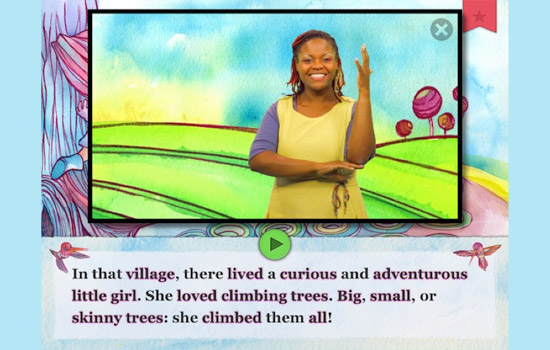
Now kids and parents, deaf and hearing alike, can enjoy and learn ASL through this cool storytelling app!  An all-deaf team at the Center for Access Technology at the National Technical Institute for the Deaf, through a collaboration with Gallaudet University’s Visual Language and Visual Learning (VL2), has released “The Baobab”, the first of a series of American Sign Language/English bilingual storybook applications for iPads and Android tablets.

screenshot of "The Baobab" showing a woman signing TREE.According to RIT University News:

“‘The Baobab’ tells a children’s story about a curious girl who goes on an adventure.  Parents may read the story to their young children, and they together can watch the story with a professional deaf storyteller.  Children can learn vocabulary through the 170-word index highlighted within the story. When those words are tapped, videos show the word being signed and fingerspelled…’The Baobab’ can be downloaded for $4.99 on iTunes.”

Find out more here.

The “Baby Fingers” Series: Cute AND Accurate

Over the years I have made no secret of my disappointment with a certain high-profile, slickly produced series of glossy board boards about signing with young children that completely disrespect American Sign Language and its users by mingling made-up gestures with actual signs and not indicating which is which.

That’s why I am so glad that the Baby Fingers series by Lora Heller (Sterling Publishing Company) exists!  This board book series combines adorable photos of young children signing with instructions for basic ASL signs that parents and children can use every day to make communication easier, reduce frustration, and increase bonding.  With topics ranging from feelings to signs to use throughout the day, this series proves that sign language board books can be both adorable and accurate.

51XGC94VF4L._SX258_BO1,204,203,200_51WC0-lB22L._SX258_BO1,204,203,200_51VDG86KGKL._SX258_BO1,204,203,200_51P01YZYZ5L._SX258_BO1,204,203,200_51MmAofV-gL._SX258_BO1,204,203,200_

Signs of Christmas

The holidays are a great time to use signs with kids – whether they’re traveling to see relatives, staying up late for midnight mass, or missing naps, holiday times can bring changes, and signing promotes security amid the chaos.

image

image

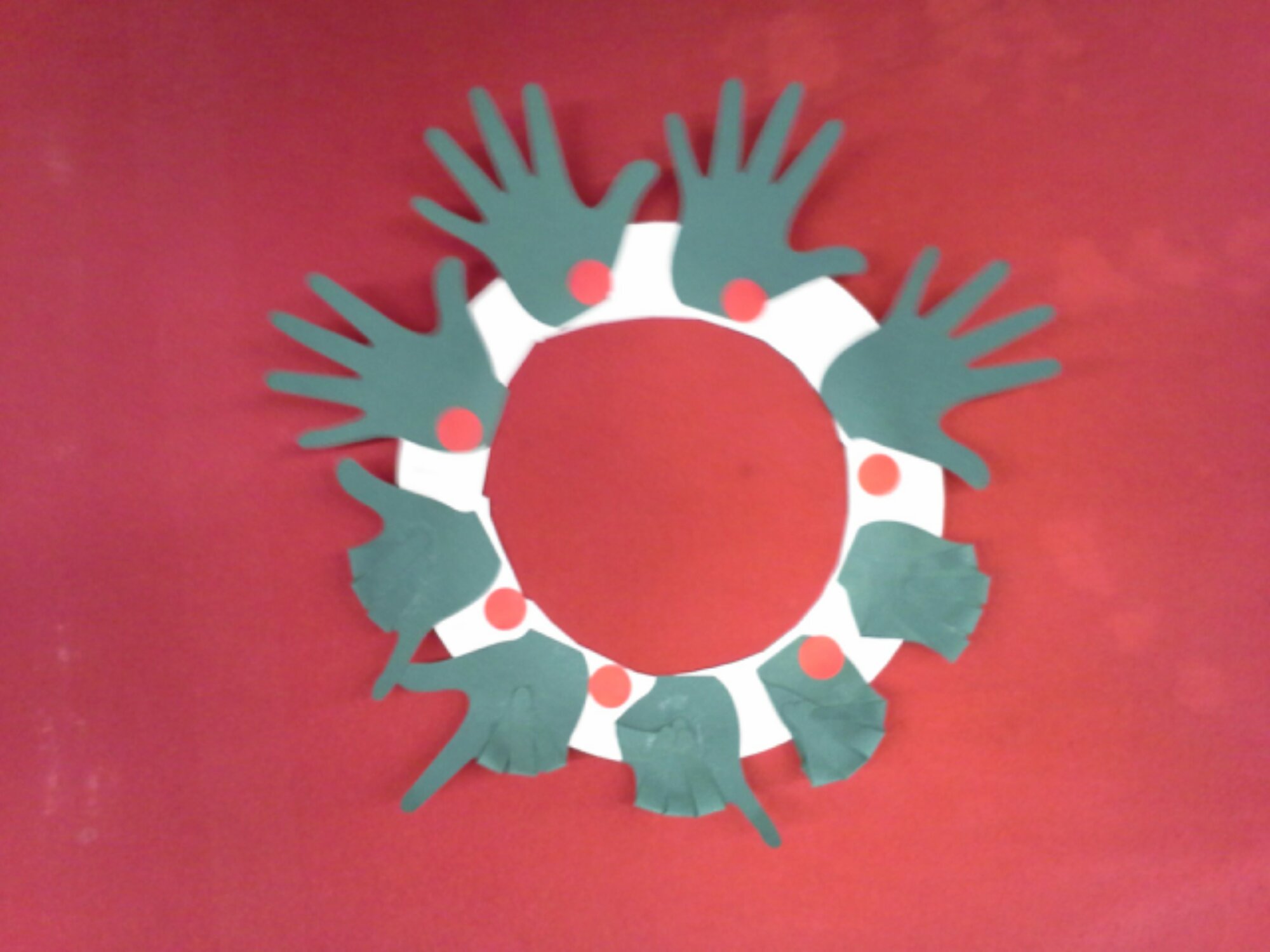
Make this ASL holiday wreath by glueing the hands into I-LOVE-YOU signs, numbers to count the days to Christmas, or letters to spell out your name! Find complete directions at http://www.storytimestuff.net.

Check out this video guide to simple Christmas signs from My Smart Hands, presented by a mom and two kids of different ages – it’s a great chance to see how those little hands actually form the signs.

Signing Helps Young Children Understand Feelings

pumpkinHalloween is the perfect time to talk about feelings with young children – and American Sign Language is a wonderful way to help children connect visual cues with feeling concepts, to help them develop an understanding of their own feelings as well as empathy for the feelings of others.  Here’s a fun song to introduce feeling signs to kids.  Extend the activity by drawing a simple pumpkin face on a whiteboard and asking the child to help you draw the appropriate expressions for each feeling.

“Pumpkin Feelings” (Click on the links to see videos of the key signs)

If you’re a happy pumpkin, clap your hands.

If you’re a happy pumpkin, clap your hands.

If you’re a happy pumpkin, then your face will show us something, so

If you’re a happy pumpkin, clap your hands.

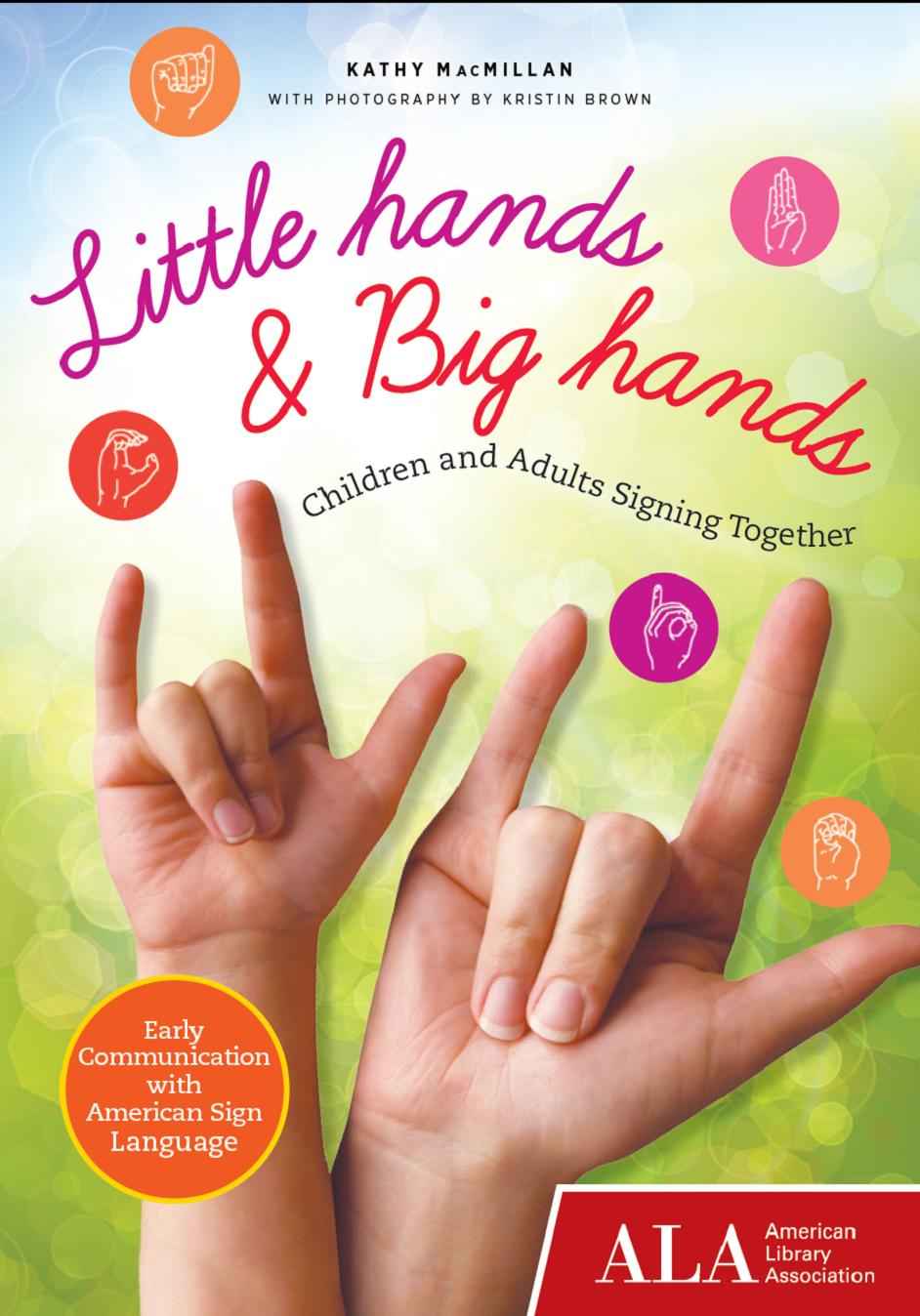
Little Hands and Big Hands coverFind more hands-on signing activities like this one in Little Hands and Big Hands: Children and Adults Signing Together by Kathy MacMillan, photographs by Kristin Brown.  (Huron Street Press, 2013).

How Signing Enhances Early Literacy

Excerpted from Little Hands and Big Hands: Children and Adults Signing Little Hands and Big Hands coverTogether by Kathy MacMillan (Chicago, IL: Huron Street Press, 2013)

Whenever you communicate with your child in an involving way, you are helping her develop early literacy skills.  Because signing encourages communication and engagement, it supports early literacy.  But that’s not the only way signing helps your child develop language and literacy skills.  In her groundbreaking book, Dancing with Words: Signing for Hearing Children’s Literacy (2001), Marilyn Daniels describes her research on using American Sign Language in preschool classrooms with hearing children.  More often than not, her research was disrupted when the parents of her control group (a preschool classroom where the teacher was not using sign language with the students) heard about the amazing gains the signing classrooms in the study were making, and insisted that their children be exposed to sign too!   She found that hearing preschoolers and kindergarteners in the signing groups achieved significantly higher scores on the Peabody Picture Vocabulary Test than those who knew no sign.  In addition, teachers in the signing classroom reported that their students were less frustrated, got along better, and were more excited about learning than their previous, non-signing classes.

How did signing with these groups produce such extraordinary results?

  • Sign language supports different learning styles.  Signs provide a visual cue and give kinesthetic learners, who learn best through physical activity, a way to interact with letters and vocabulary.
  • Knowing the names of the letters of the alphabet is an important first step on the road to literacy.  Using the manual alphabet with children helps them learn, remember, and use the letters – long before they have developed the fine motor skills to write them clearly.
  • As children move into the preschool and early elementary years, knowing signs and the manual alphabet allows them to access two different “memory stores” in their brains for reading, spelling, and vocabulary.  For example, if a child cannot identify a letter’s sound, signing it to himself may help jog his memory to make the connection.
  • American Sign Language, like any language, stimulates the language centers of the brain, strengthening synaptic connections and preparing them for further language learning.
  • Young children tend to be more visually attuned than adults, and so signing to them naturally captures their attention.  In addition, our visual sense works best when our eyes are moving, as when one is observing signs.
  • The areas of the brain that control movement develop earlier than those that control speech.  This is why even six to seven month old babies can produce signs.  As children grow up, their motor centers continue to develop ahead of their speech centers, allowing them to express more thoughts more clearly through signs than they can through speech.
  • Adults tend to use writing as a way to process and understand information.  Young children do not have access to this tool yet, but they can use signs to serve the same function.
  • The hands are connected to the brain.  Developing the tactile sense (touch) and the kinesthetic sense (movement) helps the different hemispheres of the brain communicate with one another, allowing for more seamless processing of information.
  • Before children can understand the abstract shapes of letters, they must first develop their proprioceptive system, or a sense of where they are in space.  When a child moves, proprioceptive development is triggered as muscles, joints, and tendons make contact and brain connections develop (Johnson 2007).  The movement of signs naturally encourages proprioceptive development.
  • Signing in itself seems to be intrinsically motivating for children; as one United Kingdom study reports, “Children’s motivation for acquiring basic signing skills does not appear to stem from interaction with Deaf children or adults as much as from the language itself” (Daniels 2003).
  • Signing with children facilitates a sense of play.  Play is far more than just simple entertainment – it is the number one way children learn about the world in the first five years of life.  Play allows children to make connections between concepts and understand how the pieces of the world fit together – and if children figure these things out for themselves, the resulting brain connections last far longer than if they had received direct instruction.

For more about the benefits of signing with young children, as well as fun signing activities to use with children, see Little Hands and Big Hands: Children and Adults Signing Together by Kathy MacMillan (Chicago, IL: Huron Street Press, 2013), available now!

Little Hands and Big Hands Sneak Preview: Taking Turns Bounce

Little Hands and Big Hands coverHere’s a fun and engaging bounce rhyme for babies and toddlers from my upcoming book, Little Hands and Big Hands: Children and Adults Signing Together (which you can pre-order here!).

Put your child in your lap and bounce side to side to the rhythm as you say the rhyme.

Taking turns is fun to do

First it’s me (MY-TURN) and then it’s you (YOUR-TURN)

Back and forth and to and fro

MY TURN, YOUR TURN, here we go!

Now let’s do it slowly! (Repeat the rhyme slowly)

Now let’s do it quickly! (Repeat the rhyme quickly)

MY TURN: Tip a sideways L-handshape towards your chest.
Tip a sideways L-handshape towards the other person.

A note about the signs: The signs MY-TURN and YOUR-TURN are both wonderful examples of the economy of space and directionality in American Sign Language!  When signing MY-TURN, the palm of the hand should be facing you.  When signing YOUR-TURN, the back of your hand should be facing the person whose turn it is.  You can also show a group of people taking turns by tipping the sign toward each person in turn.

Why it works:

This activity allows your child to experience and internalize language with multiple senses – hearing the words in a rhythmic way, feeling the rhythm as you bounce her along, and seeing the signs.  The back-and-forth nature of the rhyme and the bounce also emphasizes the directionality of the sign, so that when you use it in context, your child will understand it clearly.

See a video tutorial for this bounce here.

Check out Little Hands and Big Hands: Children and Adults Signing Together for lots more fun ideas to promote early literacy through signing!

Developmental Milestones in American Sign Language

If you are signing with your baby, sometimes it can be hard to gauge your child’s progress since most language development benchmarks tend to focus on spoken language only.  The Ontario Infant Hearing Program offers comprehensive lists of developmental milestones from birth to 24 months in both sign language and spoken language on its website here.  This is a great tool to help parents and educators learn what to expect from their little signers at various ages!