Category Archives: Resources for Educators and Librarians

Celebrating a Great Partnership: Clerc-Gallaudet Week is December 3-9

At certain times throughout history, fate has brought together people who were able to do great things together, their collaborations pushing them individually to great heights.  Lennon and McCartney.  Jobs and Wozniak.  Twain and Tesla.

Perhaps lesser-known to many hearing Americans is a partnership that happened by fortunate accident but would go on to shape an educational system, a language, and eventually, an entire culture: that of Thomas Hopkins Gallaudet and Laurent Clerc, founders of the first permanent school for the deaf in the United States.
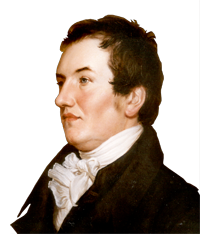
clercLaurent Clerc, born December 26, 1785 in the south of France, became deaf as a young child and spent his early years uneducated, with little to no communication with his hearing family members.  Finally, when he was twelve years old, an uncle convinced Clerc’s parents to send him to a well-known school for the deaf in Paris, the first public school for the deaf in the world.  At the school, Clerc quickly learned French Sign Language, reading, writing, philosophy, mathematics and more – so quickly that after just eight years of schooling he became a tutor and was hired as a teacher one year later.   In 1815, Clerc was selected to travel to England with the head of the Paris school for a series of demonstrations of his teaching methods – a trip that would change history.

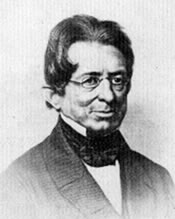
That’s because in attendance at one of those demonstrations was thgallaudet-portraitThomas Hopkins Gallaudet, a hearing man and minister from Hartford, Connecticut who had travelled to England to research deaf education methods for a proposed school for the deaf in the United States.  He had originally come to study at the Braidwood School, an institution that focused exclusively on speech and speechreading, but had been frustrated by the Braidwood family’s refusal to share their methods.  When he attended the presentation by the French educators, Gallaudet knew that he had found what he needed for the American school.  The Frenchmen invited Gallaudet back to Paris with them.
Gallaudet soon ran out of money, and recognized that he still had not learned enough to start the school on his own.  He entreated Laurent Clerc to return to the United States with him, and Clerc, moved by the plight of the uneducated deaf children in America, agreed, abandoning the cultured halls of Paris for the wilds of the New World.

On their fifty-two day sea voyage across the Atlantic, Clerc taught Gallaudet French Sign Language, and Gallaudet taught Clerc to read and write English.  In 1817, they opened the first permanent school for the deaf in Hartford, Connecticut.  Some students came from the nearby island of Martha’s Vineyard, a community with its own established deaf community and sign language.  Most students came from hearing families where they had eked out a few “home signs”, gestures to communicate enough to get by.  But all found themselves in a rich community where Clerc’s French Sign Language blended with the signs brought by his students, forming early American Sign Language and the roots of American Deaf Culture as we know it today.

Clerc and Gallaudet went on to establish or help establish schools for the deaf in many other states, and both devoted their lives to deaf education.  In December 1974, DC Public Library established Clerc-Gallaudet Week as a way of honoring Clerc and Gallaudet’s birthdays (December 26, 1785 and December 10, 1787, respectively) and promoting library awareness in the deaf community and deaf awareness in the library community.

To learn more about Clerc and Gallaudet, check out these links:


Learning American Sign Language Online

picture of computerLooking for a great site to help you learn American Sign Language, or to supplement an in-person class?  Here are three sites that fit the bill:

ASLOnline: Maintained by the University of Texas at Austin, this free online tutorial features three levels focusing on vocabulary and sentence structure in American Sign Language.  Instruction takes places through videos and written text.  The organization of the units mirrors the critically acclaimed Signing Naturally curriculum, making this site an ideal supplement to in-person classes.

ASL University: Maintained by Bill Vicars, this site features clear, well-structured lessons with a mixture of print information, video, and photos.  It also includes lots of activities for practice and an online ASL dictionary, making this a great stop for someone looking for a casual resource or a serious student looking for structured lessons.

Start ASL: This site offers three levels of free online ASL courses, as well as a fingerspelling course.  Students download a free workbook in .pdf form and use it to work through the video activities in each unit.  The free courses are quite robust, but the site also offers a more in-depth paid class option for those who want to access the courses free of advertisements, with the option to submit assignments for feedback and access additional material.

Got a great ASL instruction site to recommend?  Tell us about in the comments, or send an email to info@storiesbyhand.com!

How Signing Enhances Early Literacy

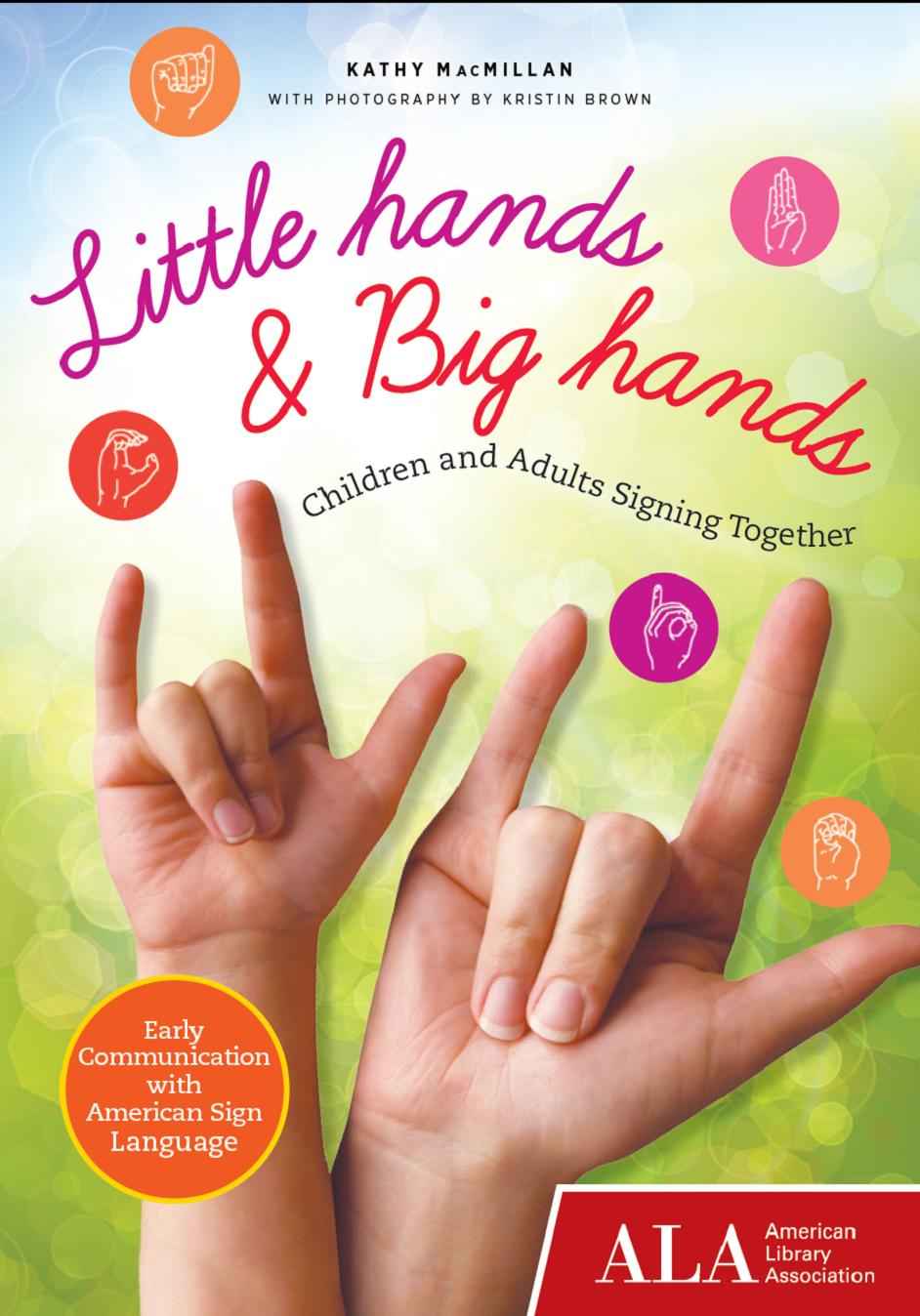
Excerpted from Little Hands and Big Hands: Children and Adults Signing Little Hands and Big Hands coverTogether by Kathy MacMillan (Chicago, IL: Huron Street Press, 2013)

Whenever you communicate with your child in an involving way, you are helping her develop early literacy skills.  Because signing encourages communication and engagement, it supports early literacy.  But that’s not the only way signing helps your child develop language and literacy skills.  In her groundbreaking book, Dancing with Words: Signing for Hearing Children’s Literacy (2001), Marilyn Daniels describes her research on using American Sign Language in preschool classrooms with hearing children.  More often than not, her research was disrupted when the parents of her control group (a preschool classroom where the teacher was not using sign language with the students) heard about the amazing gains the signing classrooms in the study were making, and insisted that their children be exposed to sign too!   She found that hearing preschoolers and kindergarteners in the signing groups achieved significantly higher scores on the Peabody Picture Vocabulary Test than those who knew no sign.  In addition, teachers in the signing classroom reported that their students were less frustrated, got along better, and were more excited about learning than their previous, non-signing classes.

How did signing with these groups produce such extraordinary results?

  • Sign language supports different learning styles.  Signs provide a visual cue and give kinesthetic learners, who learn best through physical activity, a way to interact with letters and vocabulary.
  • Knowing the names of the letters of the alphabet is an important first step on the road to literacy.  Using the manual alphabet with children helps them learn, remember, and use the letters – long before they have developed the fine motor skills to write them clearly.
  • As children move into the preschool and early elementary years, knowing signs and the manual alphabet allows them to access two different “memory stores” in their brains for reading, spelling, and vocabulary.  For example, if a child cannot identify a letter’s sound, signing it to himself may help jog his memory to make the connection.
  • American Sign Language, like any language, stimulates the language centers of the brain, strengthening synaptic connections and preparing them for further language learning.
  • Young children tend to be more visually attuned than adults, and so signing to them naturally captures their attention.  In addition, our visual sense works best when our eyes are moving, as when one is observing signs.
  • The areas of the brain that control movement develop earlier than those that control speech.  This is why even six to seven month old babies can produce signs.  As children grow up, their motor centers continue to develop ahead of their speech centers, allowing them to express more thoughts more clearly through signs than they can through speech.
  • Adults tend to use writing as a way to process and understand information.  Young children do not have access to this tool yet, but they can use signs to serve the same function.
  • The hands are connected to the brain.  Developing the tactile sense (touch) and the kinesthetic sense (movement) helps the different hemispheres of the brain communicate with one another, allowing for more seamless processing of information.
  • Before children can understand the abstract shapes of letters, they must first develop their proprioceptive system, or a sense of where they are in space.  When a child moves, proprioceptive development is triggered as muscles, joints, and tendons make contact and brain connections develop (Johnson 2007).  The movement of signs naturally encourages proprioceptive development.
  • Signing in itself seems to be intrinsically motivating for children; as one United Kingdom study reports, “Children’s motivation for acquiring basic signing skills does not appear to stem from interaction with Deaf children or adults as much as from the language itself” (Daniels 2003).
  • Signing with children facilitates a sense of play.  Play is far more than just simple entertainment – it is the number one way children learn about the world in the first five years of life.  Play allows children to make connections between concepts and understand how the pieces of the world fit together – and if children figure these things out for themselves, the resulting brain connections last far longer than if they had received direct instruction.

For more about the benefits of signing with young children, as well as fun signing activities to use with children, see Little Hands and Big Hands: Children and Adults Signing Together by Kathy MacMillan (Chicago, IL: Huron Street Press, 2013), available now!

Little Hands and Big Hands Sneak Preview: Taking Turns Bounce

Little Hands and Big Hands coverHere’s a fun and engaging bounce rhyme for babies and toddlers from my upcoming book, Little Hands and Big Hands: Children and Adults Signing Together (which you can pre-order here!).

Put your child in your lap and bounce side to side to the rhythm as you say the rhyme.

Taking turns is fun to do

First it’s me (MY-TURN) and then it’s you (YOUR-TURN)

Back and forth and to and fro

MY TURN, YOUR TURN, here we go!

Now let’s do it slowly! (Repeat the rhyme slowly)

Now let’s do it quickly! (Repeat the rhyme quickly)

MY TURN: Tip a sideways L-handshape towards your chest.
Tip a sideways L-handshape towards the other person.

A note about the signs: The signs MY-TURN and YOUR-TURN are both wonderful examples of the economy of space and directionality in American Sign Language!  When signing MY-TURN, the palm of the hand should be facing you.  When signing YOUR-TURN, the back of your hand should be facing the person whose turn it is.  You can also show a group of people taking turns by tipping the sign toward each person in turn.

Why it works:

This activity allows your child to experience and internalize language with multiple senses – hearing the words in a rhythmic way, feeling the rhythm as you bounce her along, and seeing the signs.  The back-and-forth nature of the rhyme and the bounce also emphasizes the directionality of the sign, so that when you use it in context, your child will understand it clearly.

See a video tutorial for this bounce here.

Check out Little Hands and Big Hands: Children and Adults Signing Together for lots more fun ideas to promote early literacy through signing!

Seeing Voices

Seeing Voices: A Journey Into the World of the Deaf by Oliver Sacks. New Seeing Voices coverYork: HarperCollins, 1989.

There’s a reason this book is a classic in the field of Deaf Studies: Sacks weaves together history, linguistics, and a deep understanding of culture to create a compelling introduction to American Sign Language and Deaf culture for the uninitiated.

How to Communicate with Someone who is Deaf

  • Don’t assume that every deaf person speechreads. Speechreading is a very difficult skill to master, and many deaf people don’t find it effective beyond common phrases such as “How are you?”
  • Keep your face and lips visible.
  • Maintain eye contact.
  • Make sure the deaf person is looking at you before you speak, sign, or gesture.
  • Speak naturally. Don’t exaggerate your mouth movements or speak too slowly. And don’t shout!
  • Be careful not to stand with your back to a window or other light source – this makes speechreading and getting information from facial expressions difficult.
  • Offer pen and paper to write notes back and forth, but be aware that English is a second language for many deaf people. When writing notes, use short sentences and plain language, and avoid idioms and slang.
  • Repeat the question to make sure you understand.
  • To get the attention of the deaf person, tap his or her shoulder or arm or wave in his or her line of sight.
  • ATTITUDE is the most important thing! Most deaf people will appreciate your efforts to communicate.

Library Signs Resources

Want to learn some simple signs you can use to make serving Deaf patrons more successful?  Check out these resources!

Practice Videos by Kathy MacMillan on YouTube
Manners Signs
Library Signs 1
Library Signs 2
Library Signs 3

Library Signs Quiz Video


Library Signs Quiz Video Answer Sheet


Handouts to go with Practice Videos:
Library Signs (Vocabulary – Video 2)

Library Signs (Sentences – Videos 1 and 3)