Back to the book at hand: on the surface, this is a simple, lyrical tale of mother and daughter spending a day at the beach, but every bit of it is built around the things their hands do: waving hello to the waves, digging in the sand, making a tent, and even being “Yak yak hands/yak yak fingers/telling as we run/out the gate down the path.” It’s a subtle reference to mother and child signing, and indeed, each page is accompanied by illustrations teaching a relevant sign such as RUN, WATER, or SUN. Amy Bates’ dreamy illustrations make this a sweet, gentle tale of family togetherness. A lovely addition to the ASL picture book canon.
Click on the covers above for previews of each story and purchase information.
ASL Tales proclaims itself to be “a new way of experiencing American Sign Language and English” and these engaging DVD/picture book sets truly deliver on that promise. Each DVD features a story told by a master ASL storyteller, incorporating illustrations from the accompanying picture book. Viewers can choose to engage with the story on many different levels – by watching the story in ASL only, in ASL alternating with the book illustrations, in ASL with voiceover and/or captions, or in multiple combinations of these options. Voiceover narration is available in 11 different languages – English, Cantonese, Korean, Russian, Arabic, Haitian Creole, Mandarin, Spanish, Bosnian, French, and Portuguese – making this product an ideal learning tool for families from many different language backgrounds. The ASL storytelling itself is absolutely masterful, with native signers providing beautiful language modeling.
But where ASL Tales really stands out from the pack is its “ASL Clues” feature, which allows viewers to see each individual sentence of the story in slow motion, with relevant ASL grammatical features explained on the screen. These features include use of role shift, classifiers, nonmanual signals, directionality, and nuances of vocabulary – but you won’t see linguistic terms like these on the screen. Instead, you will find user-friendly explanations of the grammatical features that can be understood easily by all. The producers have pulled off quite a feat here – making big-picture language information accessible to a wide range of learners, while at the same time providing detailed, hands-on information about the nuances of the language that will aid even upper-level ASL and interpreting students.
This feature takes ASL Tales far beyond the typical list-of-vocabulary approach (though each DVD also features a useful video glossary of relevant signs) and helps viewers understand how to put sentences and stories together in ASL. The producers have created an incredibly flexible product that is both enjoyable and enlightening, one that can be enjoyed by hearing and deaf audiences alike, and one which manages to support written, spoken, and sign language development all at once. Bravo!
Today we have a special treat – an interview with Dawn Babb Prochovnic, the author of sixteen picture books in the Story Time With Signs & Rhymes series (Abdo Publishing Group) and the founder of SmallTalk Learning. Each Story Time With Signs & Rhymes book focuses on a different topic, from animals to food to school signs, and introduces basic American Sign Language through a fun rhyming story and colorful illustrations. Dawn blogs at http://www.dawnprochovnic.com/
Without further ado, here’s the interview!
1) How did you first become interested in sign language (and in particular, signing with hearing children)?
I took an interest in sign language as a young child. I was raised on three episodes of Sesame Street a day and enjoyed watching Linda Bove use sign language to communicate. When I was in grade school I volunteered in what was then called the “special education classroom” and enjoyed using sign language in that environment.
When I started planning for my own family in the mid-1990’s, I learned about the idea of signing with hearing babies. I read books, watched videos, researched web sites and took signing classes in my local community to expand my signing vocabulary. When my first child was born in 1999, our family embraced signing as an important part of our early communication with our daughter. Signing made it possible for her to tell us what she was thinking and what she needed before she was able to clearly communicate verbally. Back then, signing was more of an alternative thing to do with your hearing baby—it was definitely not mainstream. Our positive experience garnered the attention of other families around us. Soon, friends began asking for informal workshops.
I have an MA in organizational communication, and much of my pre-kid professional life was in the field of corporate training and development, teaching grown-ups how to communicate with each other. In the year 2000, I left my corporate job and started SmallTalk Learning (www.smalltalklearning.com), a company that specializes in teaching sign language workshops to hearing families and educators. I love teaching, I love writing, and I deeply value family and communication. Teaching signing workshops and writing books for children enables me to blend all of these interests.
2) How did you come to write the “Story Time with Signs & Rhymes” series?
When I started teaching infant/toddler sign language workshops, I quickly discovered that the most effective way to help participants learn and remember particular signs was to teach them catchy songs they could sing and sign while they interacted with their babies and toddlers. I wrote all kinds of ditties for this purpose, modeled after familiar children’s songs and rhymes like “Old MacDonald Has a Farm” and “Oh My Darlin’ Clementine.”
Over time, I became more interested in the early literacy benefits of signing in addition to the pre-verbal benefits, and I discovered that preschoolers and elementary school children were especially keen on sign language. I wanted to share the extraordinary experience of signing with more children than I could reach in my own classes. The “Story Time with Signs & Rhymes” series grew out of that vision.
In the summer of 2004, I attended my first of many writing conferences, and I formed a critique group so that I could refine my writing skills, transform my classroom songs into stories, and learn about the business of publishing. After many rounds of critique, countless revisions, and heaps of submissions and rejections, I signed my first publishing contract in March of 2008. I currently have 16 books that have been published in the series.
3) What made you decide to take a story-like approach to the series, when so many ASL books take a nonfiction approach?
I was trying to fill an unmet need. As baby signing shifted from alternative to mainstream, a variety of sign language resources became available: board books and picture dictionaries for babies, instructive books for middle graders, “How to Sign with Your Baby” guidebooks for parents, and many different videos and websites. At the time, there were a few fairy tales and nursery rhymes translated into Signed English, but there were no original, story-based picture books for preschool and elementary aged children that incorporated sign language. The Story Time series was designed to give children interested in ASL a logical next step after board books and picture dictionaries.
The playful, rhythmic, nature of the stories encourages parents and caregivers to read, sign and rhyme with their children, which helps build early literacy skills. My overall goal for the series was to create stories for children to interact with and get hooked on reading and signing.
4) Tell us a bit about the process for each book. How do you decide on the topics? How much do you collaborate with the illustrator?
Most of the themes for the stories grew out of the songs I sing in my signing workshops to teach the signs for early childhood concepts such as animals, colors, and things-that-go. Each book tells an original story that is fun to read/chant/sing with children while they sign along with key words in the text. Think: “The Wheels on the Bus,” or “The Itsy Bitsy Spider,” but instead of incorporating random hand gestures for “round and round,” and “up the water spout,” children can sign along with key words like “red,” “blue,” and “green” that repeat throughout the story. Each page spread includes a small “sign language reminder picture” to encourages readers to sign along with at least one word on each page.
The series illustrator, Stephanie Bauer, had a lot of autonomy in creating the traditional picture book art, but we both worked closely with the ASL Content Consultants (William Vicars, EdD and Lora Heller, MS) on the non-fiction aspects of the books. Each glossary illustration went through several rounds of review before they were finalized. It is very difficult to convey a three-dimensional language via two-dimensional artwork, but Stephanie did a great job.
5) Do you have any new books in the works now?
I have several new projects in the works, but nothing currently under contract with a publisher. I have written a new character-driven sign language series, and I’ve completed several new picture books that are completely unrelated to signing. Two of my favorites: LUCY’S BLOOMS, about the magic of childhood firmly rooted in unconditional love, and WHERE DOES A PIRATE GO POTTY?, about a pirate’s quest to find the right spot to leave his . . . uh, treasure. [Note from Kathy: Can’t WAIT for this one!] I also have a few grown-up projects under development. My current professional goal is to sign with a literary agent so I can focus on writing new books and engaging with readers.
6) Tell us a little about what you do in your presentations at schools and libraries.
I teach a wide variety of classes for a wide range of participants including Baby and Me classes for preverbal infants/toddlers and their parents/caregivers; Early Literacy Enrichment classes for toddlers and preschoolers; Young Writers Workshops for school-aged children; and Professional Development workshops for caregivers, educators, and librarians. Just about every workshop includes some singing, a lot of signing, some moving and grooving, and a sign-along story time!
7) How do you respond to people who are hesitant to sign with their children due to concerns that signing will delay/interrupt speech?
Ah, the persistent myth . . .First, I take a deep breath. Then, I point them to the research that indicates that just the opposite is true (babies who sign tend to verbalize sooner and have broader vocabularies than babies who do not sign, and there is a growing body of research that shows that early exposure to sign language contributes to future literacy benefits).
I encourage folks to think about anecdotal evidence that points to the idea that signing does not interrupt the developmental milestone of speech. For example, when a child is diagnosed with a speech delay, it is quite common that sign language will be prescribed as a therapy to help stimulate speech and language development. With this in mind, it is quite illogical to think that signing is the cause of speech delays.
I also suggest folks think about how babies naturally learn to point and reach and wave, and how that does not inhibit their ability (or interest in) in saying, “Look,” “Up,” or “Bye-Bye.” And, I encourage folks to think about the relationship of crawling and walking. Babies are developmentally able to crawl before they can walk. We do not think of crawling as an inhibitor to walking. In fact, it is widely believed that crawling is an important developmental milestone that should be accomplished prior to walking.
Finally, I invite people to stop by my house to see if they can get a word in edgewise with my two kids (both prolific signers in their pre-verbal days). : )
8) What are your favorite resources for those interested in signing with their children?
2014 is the 50th anniversary of the acoustic coupler or modem, which patent James H. Weitbrecht received in 1964, the same year he, Dr. James Marsters, and Andrew Saks founded Applied Communications Corp. Four years later in 1968, H. Latham and Nancy Breunig representing the Oral Deaf Section of the Alexander Graham Association for the Deaf and Hard of Hearing (AG Bell) and Jesse M. Smith of National Association of the Deaf (NAD) formed what is now known as TDI. Breunig was selected the first TDI president. Six years later on June 13-15, 1974, TDI had its first international conference, held in Chicago. Find out more about TDI’s work for access at http://tdiforaccess.org/
TDI eNotes is the electronic newsletter of TDI. It is distributed to subscribers and contains announcements concerning TDI events such as conferences, as well as news items pertaining to telecommunications, media, and information technology access for deaf and hard of hearing people. You may freely copy and distribute any or all portions of TDI eNotes with credit given to TDI. Anyone can subscribe to TDI eNotes, which is ABSOLUTELY FREE. You don’t have to be a member of TDI in order to receive the electronic newsletter. You can subscribe to TDI eNotes here: https://www.tdiforaccess.org/enote_subscription.aspx?key=eNote%20Subscription&select=
On May 15, 2014, Maryland Governor Martin O’Malley signed into law a historic bill establishing the Deaf Culture Digital Library (DCDL). The mission of the DCDL, which will be run by Maryland’s Department of Library Development Services, is to provide “leadership and guidance in offering resources about deaf culture, acquiring and preserving an excellent collection of deaf resources in digital formats, and furnishing access to information regardless of location and, providing highly competent assistance to Maryland residents and library staff in local public library systems, academic librarians in colleges and universities, and other libraries in the state of Maryland.” Strategic initiatives of the Deaf Culture Digital Library include:
Establishing the DCDL as an online central resource for Maryland library customers and staff, including information for deaf and hard-of-hearing people, parents of deaf children, and businesses and organizations providing access
Conducting needs assessments and providing training to library staff to improve Maryland library service to deaf customers
Developing deaf related programs and materials for libraries
Developing and supporting alliances between libraries and key deaf-related organizations
Congratulations to the state of Maryland for taking the lead in improving library service to the deaf community! Here’s hoping other states will follow Maryland’s lead.
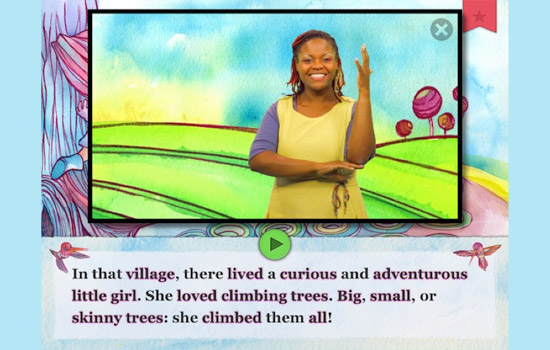
Now kids and parents, deaf and hearing alike, can enjoy and learn ASL through this cool storytelling app! An all-deaf team at the Center for Access Technology at the National Technical Institute for the Deaf, through a collaboration with Gallaudet University’s Visual Language and Visual Learning (VL2), has released “The Baobab”, the first of a series of American Sign Language/English bilingual storybook applications for iPads and Android tablets.
“‘The Baobab’ tells a children’s story about a curious girl who goes on an adventure. Parents may read the story to their young children, and they together can watch the story with a professional deaf storyteller. Children can learn vocabulary through the 170-word index highlighted within the story. When those words are tapped, videos show the word being signed and fingerspelled…’The Baobab’ can be downloaded for $4.99 on iTunes.”
For over 300 years, the tiny island of Martha’s Vineyard, located off the coast of Massachusetts, was something of a Deaf utopia – not because it was the bastion of a strong Deaf culture, but because it was the home of a bilingual community of hearing and deaf people, where deaf islanders participated fully in all aspects of life. That’s because the small, self-contained society had a high incidence of deafness – in the town of Chilmark, 1 in 25 residents were born deaf. This led to all members of the society using Martha’s Vineyard Sign Language (one of the seeds of modern ASL) alongside English.
Or check out Nora Groce’s remarkable book, Everyone Here Spoke Sign Language: Hereditary Deafness on Martha’s Vineyard (Harvard University Press, 1988).
It just goes to show: when communication is present, our differences no longer divide us.
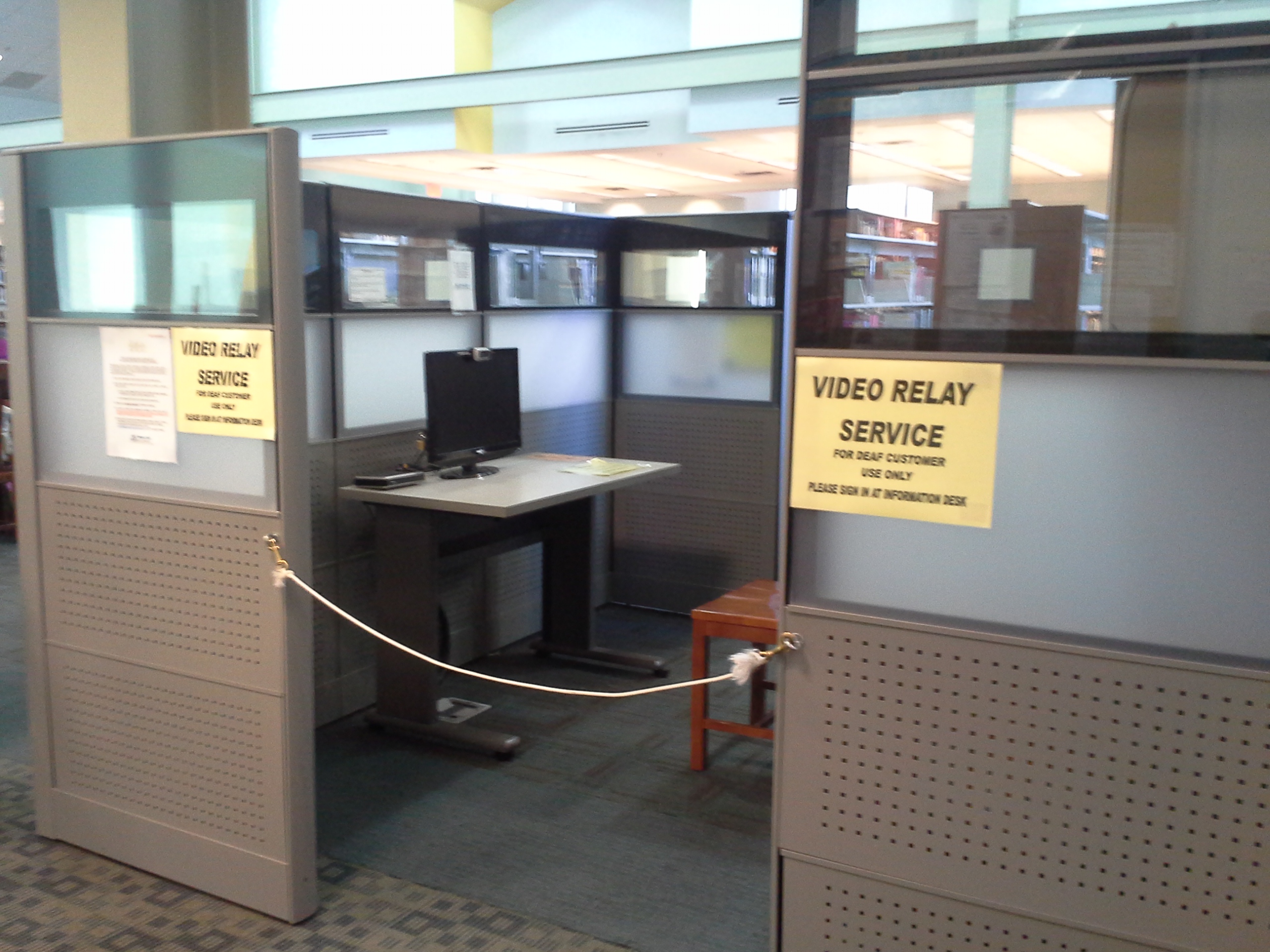
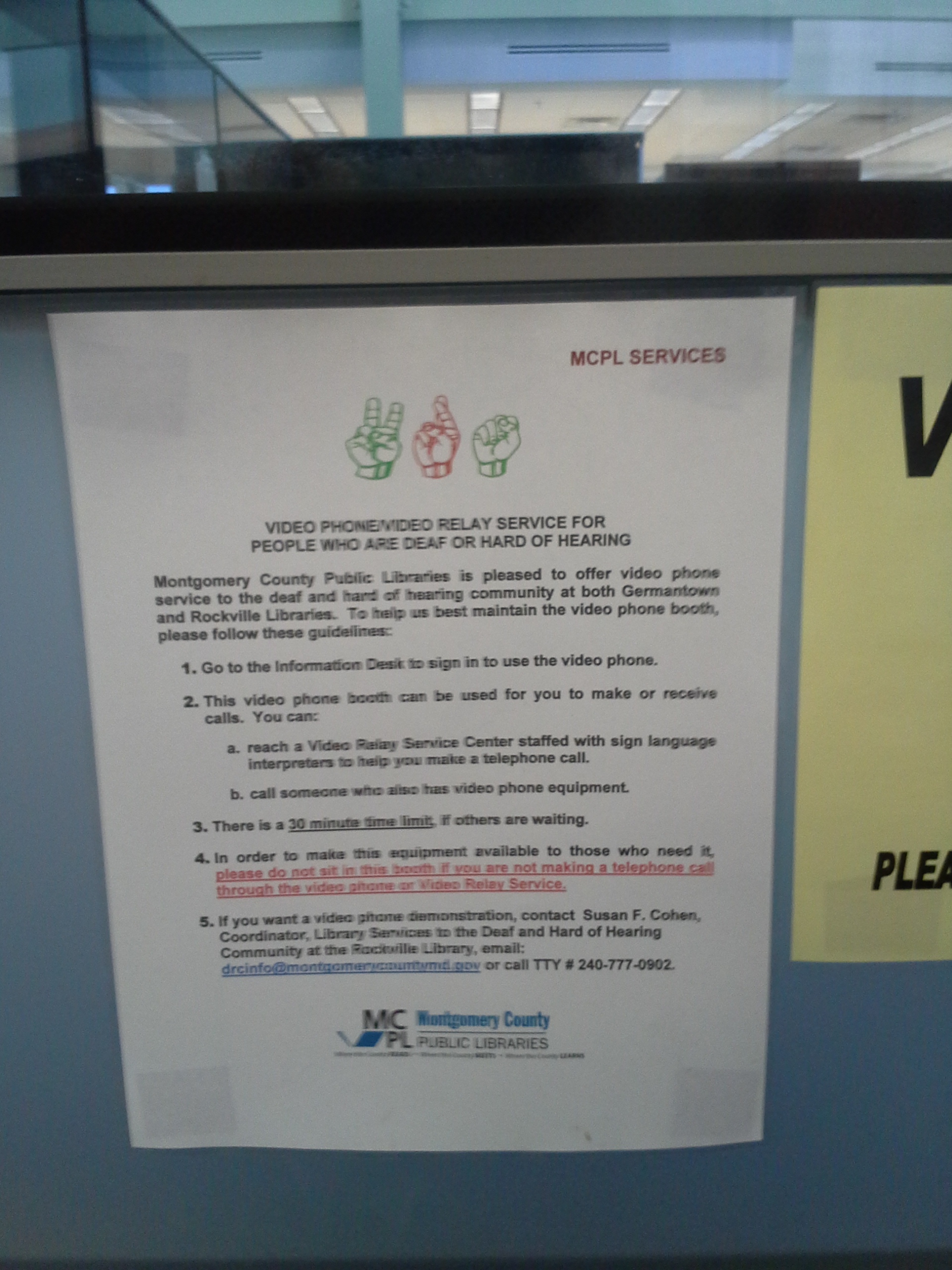
More and more libraries are offering videophone services for Deaf patrons! These technology set-ups allow Deaf patrons to make calls to other videophone users and/or access Video Relay Services to make phone calls to hearing people. Check out the set-up at the Germantown Library in Montgomery County, MD:
Over at the ALSC Blog (the official blog of the Association for Library Services to Children, a division of the American Library Association), Renee Grassi has gathered a terrific selection of resources to for signing in the library. Says Grassi: “Just as we serve patrons in our public libraries who may speak Mandarin, Spanish, Polish, or Arabic, we may also serve those whose first language is American Sign Language. How, then, can we make our libraries an inclusive and welcoming place for those patrons? We can incorporate ASL into library services, library programming, and include it in staff training. Even if we may not notice (at first) any of our library users whose first language is ASL, we still have an opportunity to introduce and expose families to a hands-on second language that is engaging and fun. How do we do that? We learn, of course!”
The holidays are a great time to use signs with kids – whether they’re traveling to see relatives, staying up late for midnight mass, or missing naps, holiday times can bring changes, and signing promotes security amid the chaos.
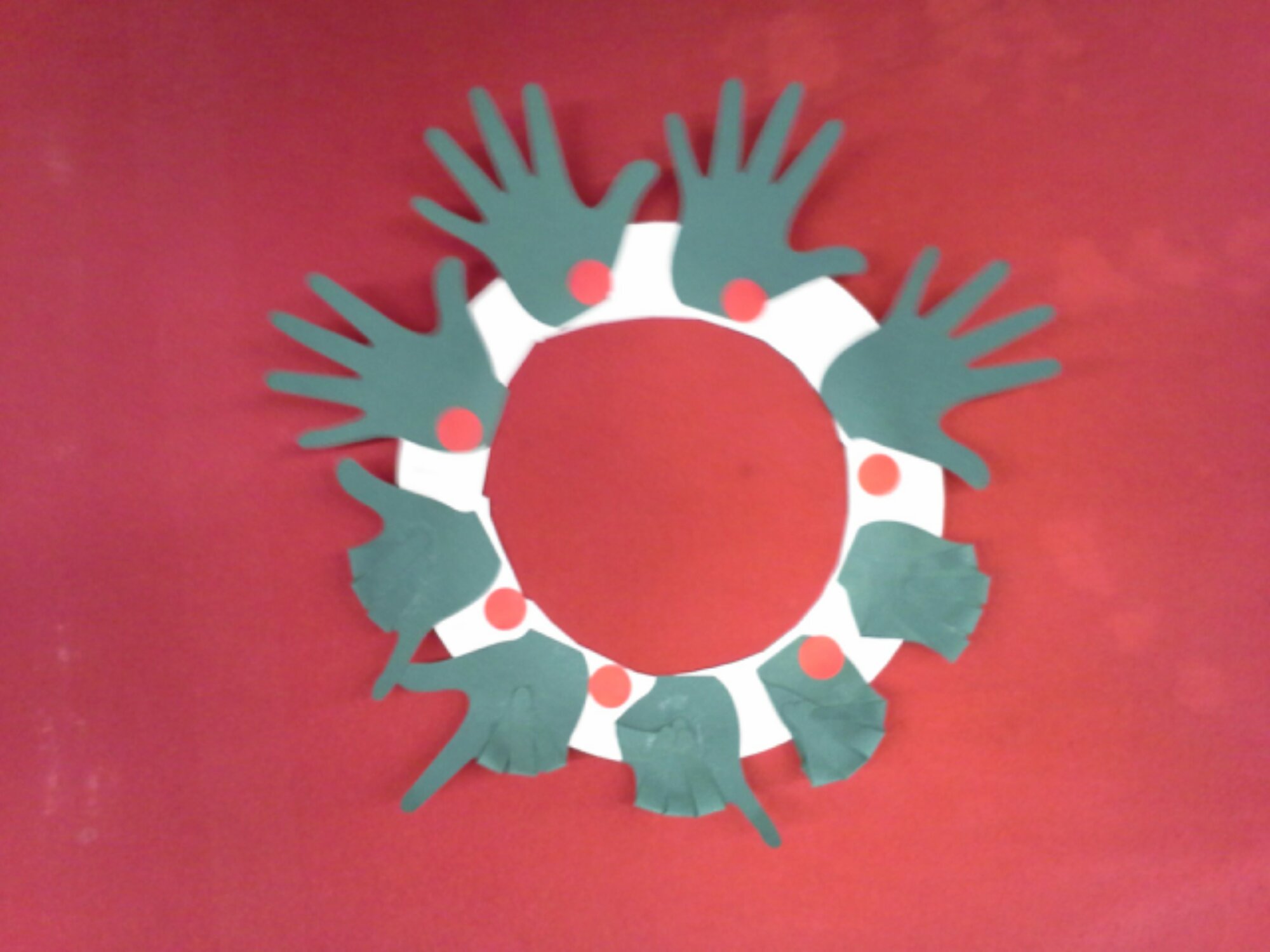
Make this ASL holiday wreath by glueing the hands into I-LOVE-YOU signs, numbers to count the days to Christmas, or letters to spell out your name! Find complete directions at http://www.storytimestuff.net.
 Hands and Hearts by Donna Jo Napoli. New York: Abrams, 2014.




 Stories by Hand with Kathy MacMillan