All posts by kathymacmillan

Little Hands and Big Hands Sneak Preview: Taking Turns Bounce

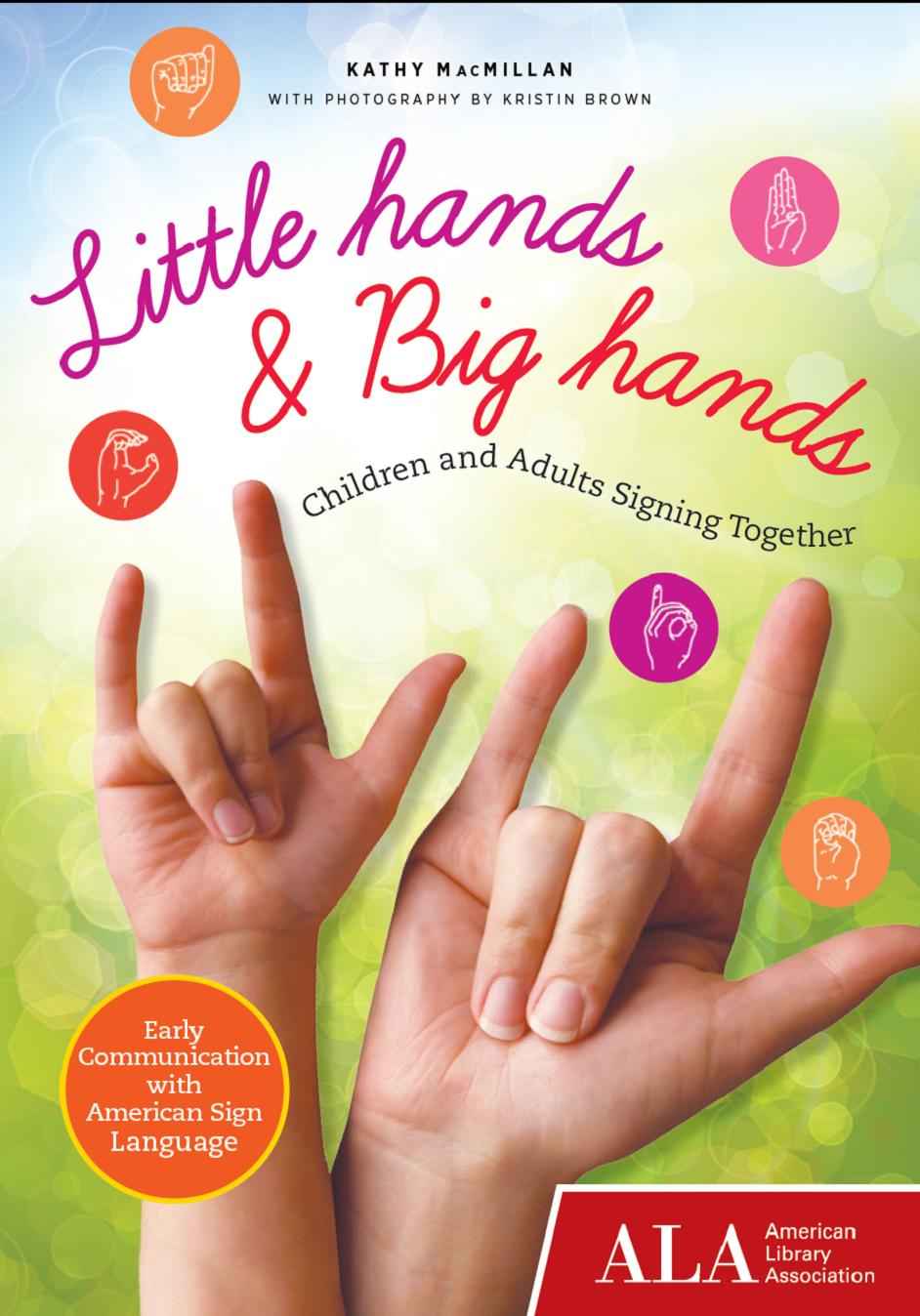
Little Hands and Big Hands coverHere’s a fun and engaging bounce rhyme for babies and toddlers from my upcoming book, Little Hands and Big Hands: Children and Adults Signing Together (which you can pre-order here!).

Put your child in your lap and bounce side to side to the rhythm as you say the rhyme.

Taking turns is fun to do

First it’s me (MY-TURN) and then it’s you (YOUR-TURN)

Back and forth and to and fro

MY TURN, YOUR TURN, here we go!

Now let’s do it slowly! (Repeat the rhyme slowly)

Now let’s do it quickly! (Repeat the rhyme quickly)

MY TURN: Tip a sideways L-handshape towards your chest.
Tip a sideways L-handshape towards the other person.

A note about the signs: The signs MY-TURN and YOUR-TURN are both wonderful examples of the economy of space and directionality in American Sign Language!  When signing MY-TURN, the palm of the hand should be facing you.  When signing YOUR-TURN, the back of your hand should be facing the person whose turn it is.  You can also show a group of people taking turns by tipping the sign toward each person in turn.

Why it works:

This activity allows your child to experience and internalize language with multiple senses – hearing the words in a rhythmic way, feeling the rhythm as you bounce her along, and seeing the signs.  The back-and-forth nature of the rhyme and the bounce also emphasizes the directionality of the sign, so that when you use it in context, your child will understand it clearly.

See a video tutorial for this bounce here.

Check out Little Hands and Big Hands: Children and Adults Signing Together for lots more fun ideas to promote early literacy through signing!

Stories By Hand Featured in Baltimore’s Child

BCCover0713

“In her presentations at libraries, child care centers, and schools, storyteller Kathy MacMillan always makes her audience members part of the show, whether it’s getting them to move their hands like butterflies, pretend to dig for treasure, or act like dinosaurs. Incorporating music, costumes, props, and, most importantly, movement, MacMillan’s goal is to keep her audience engaged while providing them with an introduction to American Sign Language (ASL).”

 Read the full article.

Seeing Voices

Seeing Voices: A Journey Into the World of the Deaf by Oliver Sacks. New Seeing Voices coverYork: HarperCollins, 1989.

There’s a reason this book is a classic in the field of Deaf Studies: Sacks weaves together history, linguistics, and a deep understanding of culture to create a compelling introduction to American Sign Language and Deaf culture for the uninitiated.

How to Communicate with Someone who is Deaf

  • Don’t assume that every deaf person speechreads. Speechreading is a very difficult skill to master, and many deaf people don’t find it effective beyond common phrases such as “How are you?”
  • Keep your face and lips visible.
  • Maintain eye contact.
  • Make sure the deaf person is looking at you before you speak, sign, or gesture.
  • Speak naturally. Don’t exaggerate your mouth movements or speak too slowly. And don’t shout!
  • Be careful not to stand with your back to a window or other light source – this makes speechreading and getting information from facial expressions difficult.
  • Offer pen and paper to write notes back and forth, but be aware that English is a second language for many deaf people. When writing notes, use short sentences and plain language, and avoid idioms and slang.
  • Repeat the question to make sure you understand.
  • To get the attention of the deaf person, tap his or her shoulder or arm or wave in his or her line of sight.
  • ATTITUDE is the most important thing! Most deaf people will appreciate your efforts to communicate.

Signing with Young Children

Why Do It?

  • Children can learn to sign long before they have the ability to speak. Using sign language with your baby can reduce frustration for both of you. Your baby can tell you exactly what he wants!
  • Children exposed to sign language early in life will not only find it easy to learn ASL later, they will find it easier to learn ANY language later.
  • Early exposure to language may increase I.Q., social skills, and create deeper bonds between parent and child.
  • Sign language is not only good for your baby, it’s fun! And it’s not just for babies either – keep up the learning as your child begins to speak, and you and your child can develop a second language together.

Tips for Signing with Your Child

  • Teach the signs for everyday objects and activities first. Use the objects to reinforce the signs often, until your child begins to sign it back. Remember, they can understand you before they sign it back, so keeping using it.
  • If the child begins to sign back, reward him or her with lots of smiles and hugs and kisses.
  • Be consistent. Make sure you use the same sign each time for the same object.
  • Use your face. 80% of ASL is on your face and body, NOT your hands. The sign “HAPPY” doesn’t mean “happy” unless you’re smiling!
  • Accept your baby’s signing style. Babies won’t always make a sign correctly the first time they sign it, just like they won’t speak a word correctly the first time they speak it. Keep signing it the correct way and your baby will soon learn.
  • Reinforce signs throughout the day to help you both remember them. You can learn signs from books, though videos and live people are usually a lot easier. See the other side of this sheet for great resources to help you both learn.
  • There are lots of places to sign! You can use sign language at home, in the car, at the park, while reading stories. You can also make the signs in different places to help your baby understand. Sometimes sign it on her, on the book, or on yourself.
  • When using signs with your baby, it’s a good idea to use American Sign Language. There’s a big difference between American Sign Language, which is a whole language, and Signed English, which is just a manual code to represent English words. By using ASL, you’re giving your child (and yourself) a chance to learn another language!

Library Signs Resources

Want to learn some simple signs you can use to make serving Deaf patrons more successful?  Check out these resources!

Practice Videos by Kathy MacMillan on YouTube
Manners Signs
Library Signs 1
Library Signs 2
Library Signs 3

Library Signs Quiz Video


Library Signs Quiz Video Answer Sheet


Handouts to go with Practice Videos:
Library Signs (Vocabulary – Video 2)

Library Signs (Sentences – Videos 1 and 3)

The Basics of Working with an Interpreter

What does an interpreter do?

An interpreter facilitates communication between people who use different languages. An interpreter must be skilled in both languages, as well as skilled in the process of interpreting.

What does an American Sign Language (ASL) interpreter do?

An ASL interpreter facilitates communication between hearing people who don’t sign and deaf people who use American Sign Language.

The Americans with Disabilities Act (ADA) requires the provision of qualified interpreters for services provided by state and local governments, public accommodations, commercial facilities, and private entities related to educational and occupational certification.

How do I know if an interpreter is “qualified”?

The Registry of Interpreters for the Deaf provides testing for national certification. The National Association of the Deaf has also provided such testing in the past; currently the RID and NAD systems have been combined into the National Interpreter Certification (NIC), administered by RID. Some states have their own licensure or separate testing systems. Interpreters may also hold degrees from various interpreter training programs throughout the country. Though some states require state licensure or certification, in many other states no certifications are currently required to work as an interpreter.  When hiring an interpreter directly, certification is your assurance that the interpreter has been screened by a knowledgeable panel and deemed skilled.  When hiring an interpreter through an agency, be sure to ask about the agency’s screening process. 

When scheduling an interpreter, be prepared to provide this important information:

  • date and time
  • setting (job interview, staff meeting, awards ceremony, etc.)
  • the length of the assignment
  • the number of deaf and hearing people who will attend
  • the deaf person’s name (if known)
  • contact person’s name and phone number
  • directions and parking instructions
  • as much information as possible about the setting and content, including speaker outlines, agendas, programs, whether there will be a visual presentation such as a video, etc.

The more information the interpreter has ahead of time, the more effective the communication experience can be for everyone!

When working with an interpreter:

  • Allow time beforehand for the interpreter to preconference with the presenter or meeting leader.
  • Work with the interpreter in advance to decide how such issues as turn-taking and interrupting for clarification will be handled.
  • Remember that the interpreter will interpret everything she sees and hears. If you don’t want it interpreted, don’t say it!
  • Look at and speak to the deaf person, not the interpreter.
  • Remember that the interpreter will be using processing time and so will be at least a few words behind the speaker. Allow time for deaf participants to receive the message and respond to any questions asked.
  • If the participants will have visual information to study, make sure to allow time for the deaf participants to watch these things and then the interpreter sequentially.
  • Remember that the interpreter will need breaks – don’t expect a single interpreter to work for two hours straight.

Additional resources:

Registry of Interpreters for the Deaf: http://www.rid.org

The official website of the Registry of Interpreters for the Deaf includes information on how to become an interpreter, information for consumers on hiring and working with interpreters, and a variety of useful “Standard Practice Papers” on topic such as business practices for interpreters, coordinating interpreters for conferences, and working with interpreters in specialized settings such as legal and medical sites.

Northeast Technical Assistance Center: How to Hire a Qualified Interpreter http://www.netac.rit.edu/downloads/TPSHT_Hire_Qual_Interp.pdf

Gives specific advice on how to find a qualified interpreter.

Laurent Clerc National Deaf Education Center: http://clerccenter.gallaudet.edu/

The premiere source of information about deafness online, with fact sheets, teacher guides, information about assistive devices, and more.