All posts by kathymacmillan

An Interview with Nancy Churnin, author of THE WILLIAM HOY STORY

A few days ago, I posted my review of Nancy Churnin’s terrific new picture book, The William Hoy Story.  Today, I am excited to share an interview with the author herself!
 .
.

.About the Book:

The William Hoy Story: How a Deaf Baseball Player Changed the Game
By Nancy Churnin
Illustrated by Jez Tuya
All William Ellsworth Hoy wanted to do was play baseball. After losing out on a spot on the local deaf team, William practiced even harder—eventually earning a position on a professional team. But his struggle was far from over. In addition to the prejudice Hoy faced, he could not hear the umpires’ calls. One day he asked the umpire to use hand signals: strike, ball, out. That day he not only got on base but also changed the way the game was played forever. William “Dummy” Hoy became one of the greatest and most beloved players of his time! 

 .
.
.

About the Author

Nancy Churnin is the author of five non-fiction picture book biographies. Her debut, The William Hoy Story: How a Deaf Baseball Player Changed the Game, published by Albert Whitman & Company in March 2016, received a glowing review in The New York Times and was featured in People magazine and USA Today Sports Weekly. William Hoy is a 2017 Storytelling World Resource Award Honor Book and a 2017 North Texas Book Festival Best Children’s Books finalist and is on several book lists: the 2016 New York Public Library Best Books for Kids; the 2017 Texas Library Association 2×2 Reading List and Topaz Nonfiction Reading List; the 2017 Best Children’s Books of the Year, Bank Street College and the 2018 Illinois Monarch Award Master List. Her second book, Manjhi Moves a Mountain (Creston Books), will be published Sept. 1, 2017 and is a fall 2017 Junior Library Guild selection. Coming up in 2018: Charlie Takes His Shot, How Charlie Sifford Broke the Color Barrier in Golf (Albert Whitman); Irving Berlin, the Immigrant Boy Who Made America Sing (Creston Books); The Princess and the First Christmas Tree (Albert Whitman). When she’s not writing children’s books, Nancy keeps busy as the theater critic for The Dallas Morning News. She lives in Texas with her husband, Michael Granberry, their four sons and two cats.
 .
.
.

The Interview

How did you first become interested in the story of William Hoy?
I am the theater critic for The Dallas Morning News. After I wrote a story about a fascinating play being staged at a local high school in Garland, Texas called The Signal Season of Dummy Hoy by Allen Meyer and Michael Nowak, I received a thank you e-mail from Steve Sandy of Ohio. I thanked him for his email and asked why someone from Ohio would be interested in a story about a play in a high school in Garland, Texas. Steve wrote me that he is deaf and shared his dream that more people, hearing and deaf, would know the story about this great deaf hero. Steve told me of his dream that William Hoy would be inducted into the National Baseball Hall of Fame, where he would be the first deaf player honored there. The more we discussed this, the more I knew Steve was right. I tried to figure out what I could do to help. That’s when I got the idea that if I wrote a children’s book about William Hoy, the children would help us. And so far, they have. I have personally delivered more than 800 letters from kids to the National Baseball Hall of Fame, which have been entered into his official file in the Hall of Fame library.
 .
.
What kind of research did you do while writing the story?
Steve Sandy is a friend of the Hoy family and he shared all the precious things they had entrusted with him: copies of original letters, newspaper articles, photos. Also very important: Steve gave me an education on what it was like to grow up deaf in the 19th century as William Hoy had. He sent me papers about the international conference of deaf educators in Milan in 1880, when a declaration was made that oral education was better than signing. William Hoy never spoke. He always signed. This helped me understand and be even more in awe of the enormity of what he accomplished — bringing sign language to baseball and succeeding with pride and even a sense of humor on his own terms. In addition to Steve’s help, I am very indebted to Eric Nadel, the Texas Rangers Hall of Fame announcer, who is incredibly knowledgeable about baseball history. He double-checked my baseball references and was kind enough to write a blurb for the back of the book and to read it to kids at Texas Ranger story time sessions.
 .
.

Were there any interesting tidbits about Hoy that didn’t make it into the story?

So many! One of the reasons it took me as long as it did to get to the final draft of this story (13 years, but who’s counting), was to figure out how to focus the story. I was able to add some anecdotes to the back matter, but I find kids enjoy hearing stories that didn’t make it into the book. I’ve got lots of stories, but my favorite one that didn’t make it is about his honesty. William was an amazing outfielder who made incredible catches. One day he was out in centerfield and the ball comes in very low. He catches it. The umpire calls the runner out. William shakes his head. No. The ball hit the ground. The runner was safe. One of the players on his team threw his cap on the ground because he was so mad! Years later, at the end of William’s life, a reporter asked him what his proudest moment in baseball was. William Hoy set a lot of records over the years. He even hit a grand slam to help the Chicago White Sox win the American pennant in 1901. But his proudest moment? The one where he let the umpire know the runner was safe.
 .

.
Your book presents a very human, relatable portrait of Hoy. How did you navigate the challenges of creating a story full of moving details while keeping it historically accurate?
I realized I needed to figure out what William’s dream was, how he had achieved that dream and what he and we could learn from his journey. His dream was to play baseball. He achieved his dream through persistence, hard work and realizing that the very thing that made him different from his teammates — his deafness — was his gift. His mother applauding him in sign language in the beginning of the book returns as a memory to help him in the middle of the book when he can’t seem to connect with his teammates, the opposing team or the fans. The signs not only help him succeed in making those connections and being a successful baseball player, they make baseball a better game. Finally, the sign for applause becomes a way for the fans to show their love for him. I followed my instincts in writing the story. I went back and checked with Steve Sandy and Eric Nadel to make sure I hadn’t written anything that wasn’t historically accurate. I am so happy that the book has their blessing and the blessing of the Hoy family.
 .
. 
In the book’s acknowledgements, you mention that you are on the “Hoy for the Hall” Committee, campaigning to get William Hoy inducted into the National Baseball Hall of Fame and Museum in Cooperstown, NY.  Please tell us more about the campaign and how readers can support it!
This book got its start with my determination to help Steve achieve his dream of getting William Hoy in the National Baseball Hall of Fame. Everywhere I present the book I ask kids if they think he should be in the Hall of Fame. They do! Then I ask them if they will draw pictures or write letters to the Hall of Fame. Some send me copies so I can post on my Facebook pages at Nancy Churnin Children’s Books and Nancy Churnin and on Twitter @nchurnin.  You can find the address for the National Baseball Hall of Fame in the free downloadable teachers guide on the Albert Whitman website.
 .
.
Anything else you want readers to know about the book?
This was a labor of love, which kicked off a passion to tell more true stories of people who are not well known, but should be. I have four more children’s books coming out and none of this would have been possible if I had not gotten the opportunity to tell William’s inspiring story. I am so appreciative of Steve and his wife, Bonnie, who have become such good friends to me. I am thankful for the opportunity to get to know wonderful people in the deaf community. It has been my honor and privilege to be interviewed by DPanTV alongside Steve Sandy about William Hoy, which you can see here. I am thrilled about all the people who have taken William Hoy’s story to their hearts and spread the word, through blog posts, reviews, interviews and putting the book on state reading lists because that helps get William’s story in the hands and hearts of more children.
  .

I recently heard from an 11-year-old boy I met at an airport last summer, waiting to get on a plane. I gave this little boy and his sister a copy of the book, which I autographed. Now, a year later, I received an email from the boy, saying he had been to his native Japan and saw The William Hoy Story in Japanese. He wrote that he found the books “piled up in front of the cashier as selected one of must-read books for 3rd and 4th graders during summer vacation. I was so excited and got one. I love this story!! I just wanted to let you know this great news.Thank you.” A letter like that is everything to me.
 

 .
.

Review: The William Hoy Story by Nancy Churnin


The William Hoy Story by Nancy Churnin.  Illustrated by Jez Tuya.  (Albert Whitman and Company, 2017)

William Ellsworth Hoy has long been a hero of the Deaf community – a record-setting baseball player who played for multiple National League teams and changed the way that baseball was played. Churnin’s approachable text and Tuya’s expressive illustrations take readers along with William’s struggles to be taken seriously by the hearing world – which, in the 1880s, didn’t believe a deaf player could amount to much. William proves the critics wrong through determination, grit, and talent, and soon teams and fans are clamoring for him. Many biographies of Hoy get hung up on his nickname, “Dummy”, which was a common term applied to deaf people at the time, but Churnin wisely keeps the focus on Hoy’s accomplishments throughout the story, saving such details, with contextualizing comments, for an informative afterward. A timeline of Hoy’s life offers more details for baseball lovers.

Coming soon: an interview with the author!

Library Signs Resources

Want to learn some simple signs you can use to make serving Deaf patrons more successful?  Check out these resources!

Practice Videos by Kathy MacMillan on YouTube
Manners Signs
Library Signs 1
Library Signs 2
Library Signs 3

Library Signs Quiz Video

Library Signs Quiz Video Answer Sheet


Handouts to go with Practice Videos:
Library Signs (Vocabulary – Video 2)

Library Signs (Sentences – Videos 1 and 3)


Interested in more in-depth instruction on this topic? Check out my professional development eCourses from the American Library Association.

Recommended DVD Series: Sign with Robert

I have been writing reviews of ASL materials for School Library Journal for several years now.  Whenever I get a new one, I tense a little with worry – there are some frankly awful sign language DVDs out there.

That’s why it’s such a thrill when I get to review a series that I can review as enthusiastically as this one.  Sign with Robert is well-planned-out, well-executed, and always mindful of the needs of its audience.

10-dvd-set-mmjkjn6ya0tjntjnec4wrqzdqgqz6ozstycdzcadjc

Here’s some of what I had to say in my review:

“This excellent series goes far beyond the usual introductions to American Sign Language (ASL) to create value for multiple audiences. Deaf actor and educator Robert DeMayo brings his native ASL fluency to the demonstrations of signs and discussion of culture, and the series features a clean visual style that keeps the focus on the language. The vocabulary segments go into far greater depth than most ASL materials, making the series valuable to advanced signers and interpreters as well as beginners.”

Sign with Robert is available as a 10-volume series, or by individual discs or streaming episodes.  Voiceovers and open captions are used where necessary to make sure everyone has access.


Recommended Viewing: The Sign Language Storytelling Series from Weston Woods

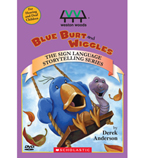
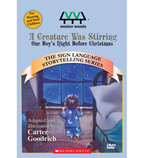
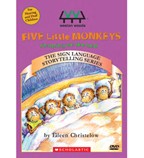
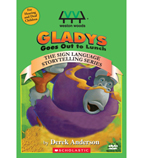
These excellent videos are perfect for both Deaf and hearing families!  Native signers Missy Keast and Manny Hernandez appear in front of the pictures and English text, telling the story on each page in American Sign Language.  Weston Woods, long known for its high-quality visual adaptations of picture books, applies its signature style to these DVDs, making them fully accessible for both Deaf audiences and hearing non-signers.  Each DVD also features:

  • optional English text on screen and English voiceover
  • a vocabulary section showing featured signs in isolation, arranged alphabetically by English translation
  • a 10-question quiz that assesses comprehension and memory
  • an optional read-along feature that highlights each word as it is spoken

Titles available in this series:

es Very Young Vol 1 DVDBig Al by Andrew Clements, illustrated by Yoshi: Big Al is large and scary-looking , so the little fish are afraid of him.Then he gets to prove what a good friend he can be!


s Very Young Vol 1 DVDBlue Burt and Wiggles by Derek Anderson: An unusual friendship develops between a bird and a worm, showing how common concerns lead to unusual friendships.


9780977097470_lgA Creature Was Stirring by Carter Goodrich: A little boy says that, despite what everyone thinks, he was the only creature stirring in the house that Christmas Eve.


ies Very Young Vol 1 DVDFive Little Monkeys Jumping on the Bed by Eileen Christelow: As soon as they say goodnight to Mama, five little monkeys start to jump on their bed. But trouble lies ahead.


s Very Young Vol 1 DVDGladys Goes Out to Lunch by Derek Anderson: One day Gladys smells something delicious and leaves the zoo to find out what it is…and the adventure begins.


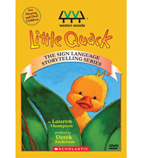
ies Very Young Vol 1 DVDLittle Quack by Lauren Thompson: Splish! Splash! Splosh! Can Little Quack find the courage to join his brothers and sisters in the pond?


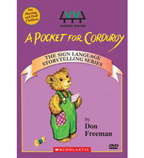
ies Very Young Vol 1 DVDA Pocket for Corduroy by Don Freeman: Corduroy, a lovable stuffed bear, gets lost. After an all-night adventure he is rescued by his owner.


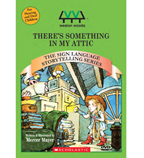
ies Very Young Vol 1 DVDThere’s Something in My Attic by Mercer Mayer: A brave little girl captures a ngihtmare to show her parents that there really is something in the attic.


You Simply Must Meet ASL Nook!

aslnook

If you are interested in signing with children, don’t miss ASL Nook!  Featuring Deaf adults Sheena McFeely and Manny Johnson, and two absolutely adorable little girls named Shaylee and Ivy, each short ASL Nook video features a theme, from school signs to patriotic signs to animal signs.  But instead of just the here’s-the-picture, here’s-the-sign approach that so many videos use, ASL Nook presents language in context, showing the adults and children interacting.  Funny, entertaining, and completely accessible to both hearing and Deaf audiences, ASL Nook is a game-changer in the world of signing with children. You can subscribe to receive updates when new videos are posted, or you can catch the videos on the website, or you can follow ASL Nook on Facebook. But whatever you do, don’t miss out!

Update on Maryland’s Deaf Culture Digital Library

The following is shared with permission.

DEAF CULTURE DIGITAL LIBRARY FACT SHEET

February 2016

The Maryland State Department of Education/Division of Library Development and Services and Montgomery County Public Libraries would like to share information on the progress of the Deaf Culture Digital Library.

The Deaf Culture Digital Library, the result of a bill that was passed into law, is the “first stop” information center that will provide Maryland residents, local public library staff, college and university librarians and other libraries in the state of Maryland with access to online resources on deaf culture, a comprehensive electronic collection of deaf resources, deaf cultural programs, and training programs for library staff.

Current Status

* The groundwork to formalize the foundation of the Deaf Cultural Digital Library is in progress. A letter of agreement between the Maryland State Department of Education/Division of Library Development and Services and Montgomery County Public Libraries (MCPL) is in progress.
* The job descriptions are currently being written and refined.

* The Division of Library Development and Services (DLDS) is working with MCPL to establish procedures to formalize the DCDL Advisory Board. DLDS will begin taking applications for membership late February 2016. The majority of board members are required to be deaf or hard of hearing and will be selected from the following entities:

  1. County library systems
  2. The Division of Library Development and Services
  3. The Governor’s Office for the Deaf and Hard of Hearing
  4. Statewide deaf and hard of hearing organizations; and,
  5. Other organizations as agreed upon by the Governor’s Office for the Deaf and Hard of Hearing and the Division of Library Development and Services

* Board members will then recruit members for the Deaf Culture Digital Library “Friends of the Library.” These individuals are expected to be strongly committed, well-positioned and able to promote community involvement, advocacy, and funding for the DCDL.

* Additional details will be announced as they become available during the months ahead.

* For more information about the Deaf Culture Digital Library, contact Susan Cohen at 301-637-2964 (videophone) or Irene Padilla, 410-767-0434.

Background

* In the 2012 Regular Session, the Maryland General Assembly passed a bill establishing a Task Force to Study the Establishment of a Deaf Culture Digital Library. http://mgaleg.maryland.gov/2012rs/bills/sb/sb0571e.pdf

* In September 2013 the eleven member task force, established to study the feasibility of the DCDL proposal, submitted a report with recommendations to the Governor. The final report to the Governor on the Deaf Culture Digital Library may be seen at: http://tinyurl.com/o3dcb7o.

*On May 15, 2014, the Maryland General Assembly passed the bill to create the Deaf Culture Digital Libraryhttp://mgaleg.maryland.gov/webmga/frmMain.aspx?id=hb0653&stab=01&pid=billpage&tab=subject3&ys=2014rs.

The credit for the concept of the library goes to numerous advocates including Alice Hagemeyer, Silver Spring Library resident and longtime advocate for the deaf community to have equal access to library services. Ms. Hagemeyer is the president and founder of the Friends of the Library for Deaf Action.
Frequently Asked Questions (FAQ)

1. Who selected MCPL as the site of the Deaf Cultural Digital Library?

The Division of Library Development and Services of the Maryland State Department of Education selected Montgomery County Public Libraries (MCPL) to manage the Deaf Cultural Digital Library (DCDL) for the state of Maryland.
2. Why was MCPL selected as the site of the DCDL?

MCPL was selected as the site of the DCDL due to its long history of providing library services to people who are deaf and hard of hearing including communication access, deaf resources, collections of materials for, by, and about people who are deaf and hard of hearing, and programs featuring deaf authors and speakers on topics related to deaf culture, and coping with hearing level changes due to aging. These services are renowned throughout the State of Maryland and across the nation.
3. Who will take the lead on this project?

Susan Cohen, Librarian II, at Montgomery County Public Libraries, will serve as the DCDL Project Coordinator. Ms. Cohen, who is deaf, has expertise in delivering library services to the deaf and hard of hearing community, deaf resources, and a long history of connections with the deaf and hard of hearing community.
4. How will this library be funded and how many staff will be hired?

State funding for the DCDL includes personnel and other resources. Two full-time library staff members will be hired to help coordinate, organize and monitor the program. The librarian is required to be a deaf or hard of hearing individual, eligible for Professional Public Librarian Certification issued by the State Superintendent of Schools, and knowledgeable about library, literacy and accessibility related issues of deaf and hard of hearing individuals.
5. How will the two staff positions support the DCDL?

Staff members in these positions will help plan and develop deaf cultural programs, give presentations about DCDL to Maryland residents and library staff, showcase library services at deaf conferences, develop and maintain the DCDL website, coordinate training sessions for library staff statewide, and support and facilitate vital statewide partnerships.


6. Where will the DCDL be located?

The DCDL, an online resource, will be available virtually to Maryland residents and library staff throughout the state of Maryland. DCDL staff will be based at the Germantown Library.

References to Legislation and Statute

Task Force Bill (SB 571): http://mgaleg.maryland.gov/2012rs/bills/sb/sb0571e.pdf

DCDL Established (HB 653): http://mgaleg.maryland.gov/webmga/frmMain.aspx?id=hb0653&stab=01&pid=billpage&tab=subject3&ys=2014rs


Chapter 606: http://mgaleg.maryland.gov/2014RS/chapters_noln/Ch_606_hb0653E.pdf

Statute 23-108: http://mgaleg.maryland.gov/webmga/frmStatutesText.aspx?article=ged&section=23-108&ext=html&session=2016RS&tab=subject5

Language and Culture in Other Worlds

Sword And Verse_cover revealFor the past ten years, while pursuing my career as an American Sign Language interpreter and storyteller, I have also been quietly pursuing another dream: to become a published novelist.  A little over a week ago, that dream became a reality when my debut young adult novel, Sword and Verse, was published by HarperTeen.  Sword and Verse is the story of a land where writing is restricted to the nobility, and a slave girl who learns the language of the gods and finds the key to saving the kingdom.  Though the story does not explicitly mention signing, it is absolutely soaked in my love of language and informed by the lessons I have learned from the Deaf community.

I am excited to share with you an interview about the book conducted by Ruth Lehrer, a fellow American Sign Language interpreter and the author of the forthcoming middle grade novel Being Fishkill (Candlewick, 2017).  We decided to do the interview in American Sign Language to make it completely accessible to our friends in the Deaf community.  (Don’t worry, nonsigners – we also provided an English transcript – mostly.  There’s a bonus, untranslated question for signers only!)

I loved the thoughtful questions Ruth asked about the role of language in the book, and I loved the opportunity to share how my experiences in the Deaf community impacted the story.  I hope you will enjoy this interview as much as I did!  Watch the interview in ASL or read it in English at the Swanky Seventeens Blog.

Sword and Verse is available in hardcover, e-book, and audio.  Read the first 9 chapters for free at Epic Reads!

Woodpecker, Woodpecker: A Signing Rhyme

Woodpecker, Woodpecker: A Signing Rhyme

Direct Link: https://youtu.be/YCT3FEC-ZY4

Begin by teaching the ASL signs TREE and BIRD. Explain that in this rhyme, you will be learning about a specific kind of bird called a woodpecker, and will be using the signs to show how the woodpecker uses the tree.

Woodpecker, woodpecker, time to eat! (sign BIRD)

Woodpecker, woodpecker, fly to the tree. (sign TREE with your other hand and move the BIRD to your forearm)

Tap-tap-tap-tap-tap-tap-tap-tap-tap-tap-tap-tap-tap! (make the bird’s beak tap quickly on your forearm, which represents the tree trunk)

Now eat up the bugs you found, just like that. (move fingers to show beak eating bugs)

Woodpecker, woodpecker, time to sleep! (sign BIRD)

Woodpecker, woodpecker, fly to the tree. (sign TREE with your other hand and move the BIRD to your forearm)

Tap-tap-tap-tap-tap-tap-tap-tap-tap-tap-tap-tap-tap! (make the bird’s beak tap quickly on your forearm, which represents the tree trunk)

Now nestle in the hole you made, cozy as can be! (nestle bird in palm of hand)

MacMillan_cover_1p.inddFind lots more great storytime activities in More Storytime Magic, the latest volume in the Storytime Magic series!